
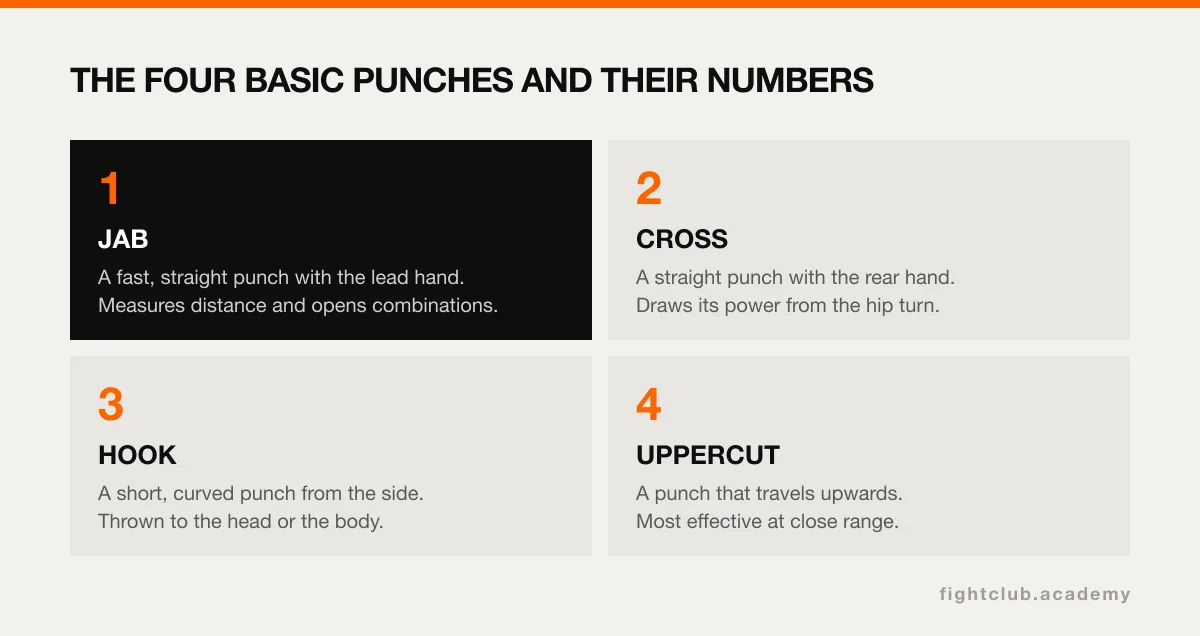
From the outside boxing looks complicated, but at its core there are only four punches: the jab, the cross, the hook and the uppercut. Every combination you see in the ring is built from different sequences of these four. Coaches use numbers to call them out quickly, so when you hear "one-two", that means a jab followed by a cross.
1: The jab
The jab is a fast, straight punch thrown with your lead hand. It's the most used punch in boxing because it measures distance, keeps your opponent busy and sets up combinations. Speed and accuracy matter more than power. As you extend your arm in a straight line, raise your shoulder slightly to protect your chin, and bring your hand back as fast as you threw it.
2: The cross
The cross is a straight punch thrown with your rear hand and is usually known as the most powerful punch. Its power doesn't come from the arm but from turning your back foot and driving your hip forward. When you lift your back heel slightly and pivot the foot inwards, your hip and shoulder rotate with it. The most common beginner mistake is throwing the cross with the arm alone, which costs power and tires the shoulder.
3: The hook
The hook is a short, curved punch that comes from the side. The arm stays bent at roughly ninety degrees, and the power again comes from rotating your torso. It can be thrown to the head or the body. The thing to watch is not swinging the arm too wide; a wide hook is slower and leaves gaps in your defence.
4: The uppercut
The uppercut travels from below upwards and is especially effective at close range. Bend your knees slightly to drop your weight, then drive up through your legs and send the punch upwards. Keep the movement short without dropping your arm too low first; otherwise your opponent can see it coming.
Common mistakes
The most common beginner mistake is leaving the hand down after a punch, which leaves your face open. The second is leaning forward and losing balance as you punch. Your weight should stay between your feet so you can return to your guard straight away. Then there's breathing: breathing out sharply with every punch adds power and helps you tire less over a round.
Your first combinations
Once each punch feels solid on its own, you can move on to short combinations. The classic beginner sequences are: 1-2 (jab, cross), 1-1-2 (two jabs and a cross) and 1-2-3 (jab, cross, hook). After every combination, bring your hands back to your face and keep your feet moving. Speed comes with time; focus first on throwing cleanly and staying balanced. Shadow boxing in front of a mirror is the easiest way to practise them.
All articles