
Most people who decide to lose weight start on a treadmill. Motivation is high in week one, the minutes start to drag in week two, and by week three the treadmill has become a very expensive clothes rack. The problem isn't willpower, it's boredom. Boxing and kickboxing offer something different here: every round has a purpose, there's a new combination to learn every week, and most of the time you don't notice the hour passing.
The single biggest factor in losing weight is consistency. A workout you can do three times a week for months without missing a beat will always beat the perfect programme you abandon after two weeks. That's where the real strength of combat sports for weight loss lies.
Why it works so well
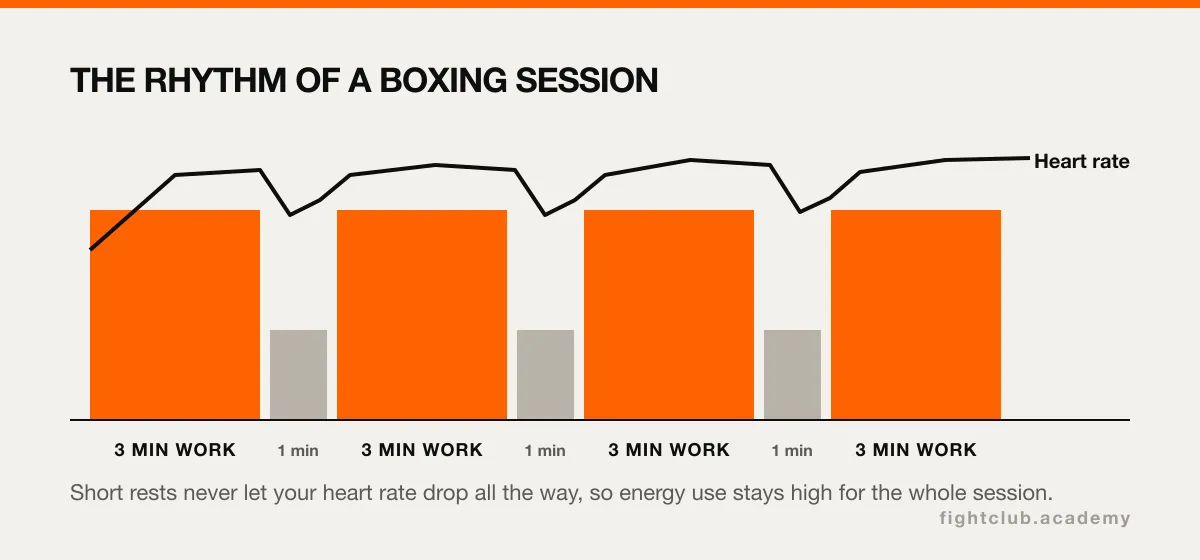
Boxing and kickboxing training is interval-based by nature. You usually work at a high pace for three minutes, rest for one and go again. Those short breaks never let your heart rate drop all the way, so your heart keeps working hard throughout the session. That structure burns far more energy than a steady walk or an easy jog over the same amount of time.
And it's not just your arms doing the work. A good punch draws power from the legs, and the hips and torso rotate to carry that power to the shoulder. Footwork keeps your legs moving the whole session, and slipping and ducking for defence keeps your core switched on. In kickboxing the kicks put even more load on your hips and legs. That full-body pace speeds up fat loss and helps you hold on to muscle, which matters, because what you're really after isn't just a lower number but a leaner, stronger body.
Boxing or kickboxing?
Both are excellent for losing weight, and the difference between them is smaller than people think. Kickboxing brings the legs into play more, so some people find it a little more tiring. Boxing builds shoulders and conditioning very quickly through footwork and fast hand combinations. What really decides it is which one you enjoy more. The session you can't wait to get to is the one that will get you to your goal in the long run.
Training alone isn't enough
It's worth being honest here: however hard you train, losing weight gets very difficult as long as you eat more than you burn. The extra appetite after training is a common trap too. Rewarding yourself after a tough class is natural, but that reward can undo an hour of work in ten minutes.
Going hungry or following strict diets isn't the answer; your energy drops, your training suffers and sooner or later you quit. Watching your portions, getting enough protein at every meal, cutting back on sugary drinks and drinking plenty of water through the day is far more sustainable. Don't neglect sleep either: someone who sleeps badly feels hungrier and recovers more slowly after training. When training and nutrition work together, the results come much faster.
What the first month looks like
In the first two weeks it's completely normal to feel sore in your shoulders, legs and muscles you didn't know you had. Starting with two or three sessions a week and leaving rest days in between makes this phase much easier. The number on the scale may not drop as fast as you'd hoped; your body can hold water while it adapts to the new load, and you may be building muscle at the same time. Plenty of people who feel disappointed by the scale at the end of month one are actually on exactly the right track.
How to track your progress
Don't rely on the scale alone. Measure your waist once a month, notice how your clothes fit and pay attention to how comfortably you get through a round. Someone who was out of breath after two rounds in their first class and comfortably finishes four a couple of months later has made progress that means far more than a few kilos on the scale. After a few months the difference shows in your energy, your sleep and your confidence as much as in the mirror.
All articles