
Almost everyone who starts boxing goes through the same thing: after their first class they want to come every day. That enthusiasm is valuable, but without the right guidance it can turn into fatigue, injury or burnout within two or three weeks. How often you should train depends on how long you've been training, your goals and the pace of your everyday life.
If you're new: two or three days a week
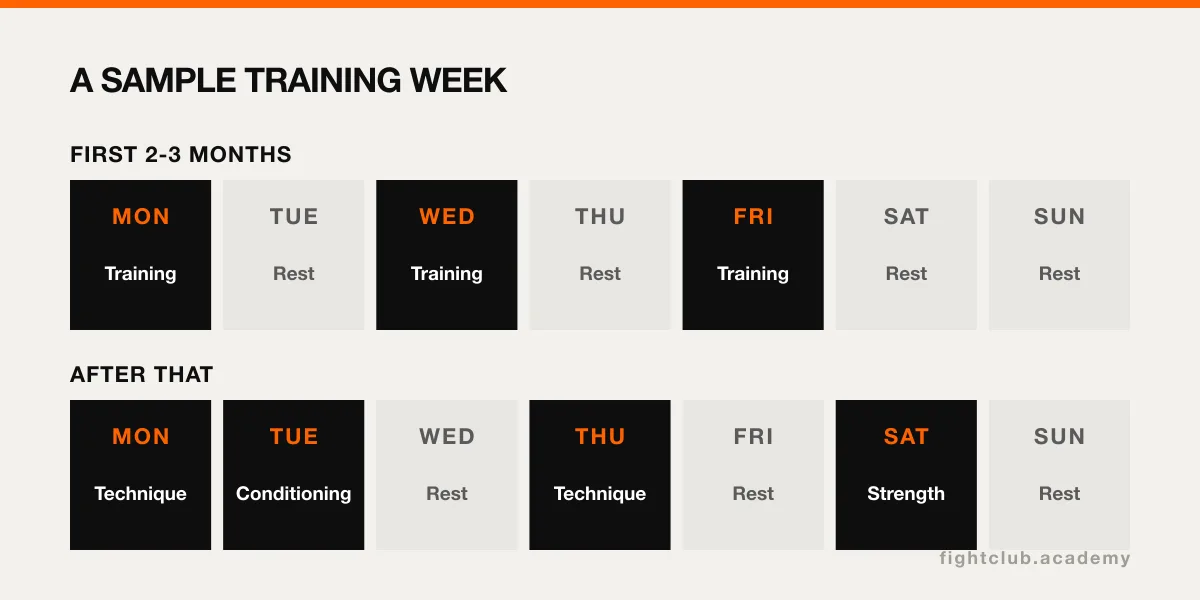
For the first two or three months, two or three sessions a week is the ideal range. Resting at least one day in between gives your body time to adapt to the new load. Boxing challenges not only your muscles but also your joints, ligaments and tendons in a new way. Muscles adapt within a few weeks, but connective tissue takes longer. Rest days are exactly when that adaptation happens.
In the first few weeks it's normal to feel sore in your shoulders, legs and muscles you didn't know you had. Jumping into another hard session before that soreness fades won't speed up your progress; it just raises the risk of injury and makes your technique fall apart.
A few months in: mix up your sessions
Once your body is used to the load, usually after a few months, you can build up to three or four days a week. At that point it really helps if not every session is the same. Putting the emphasis on technique one day, conditioning the next and strength on another keeps things interesting and develops your body in a balanced way. Not hammering the same muscle groups at high intensity on back-to-back days also makes recovery easier.
For most people without competition goals, four sessions a week is more than enough. Going beyond that only makes sense with good sleep, a balanced diet and a planned programme.
A rest day isn't a wasted day
You don't have to sit completely still on rest days. A light walk, a short stretch or some mobility work improves circulation and helps your muscles recover faster. Real progress doesn't happen during training but afterwards, while you rest. A body that's loaded constantly without rest doesn't get stronger, it gets tired.
Listen to the signals your body sends
Some signs tell you it's time to cut back for a while: constantly waking up tired, joint or muscle pain that won't go away, poor sleep, losing the urge to train and a drop in performance. If you're experiencing several of these at once, easing off for a week will pay off far more in the long run.
In the end, consistency matters more than intensity. Someone who trains twice a week without missing a beat for six months will get much further than someone who trains every day for three weeks and then quits. Pick a pace you can sustain and stick with it.
All articles