
Shadow boxing means working on punches and movement against an imaginary opponent, with no partner or heavy bag in front of you. It can sound a bit strange at first; you might wonder what good it does to punch thin air. But almost every professional boxer starts their sessions with shadow boxing, and some do it in the changing room before a fight. There's a reason for that.
Why it matters so much
On the heavy bag your punch hits a target, and that impact can hide your mistakes. In shadow boxing nothing stops you, so everything shows: whether your guard drops, your back foot lags or your shoulder rises. That's why shadow boxing is one of the most effective ways to lock in technique and build the moves you've just learned into muscle memory. It's also a perfect warm-up: it loosens your joints, raises your heart rate gradually and gets your head into the session.
There's a practical side too. Because it needs no equipment, you can do it at home, in a park or even in a hotel room. On days when you can't make it to the gym, fifteen minutes of shadow boxing is an easy way to keep what you've learned and stay in shape.
Tips for doing it right
Work in front of a mirror if you can. Seeing whether your guard drops, whether your shoulders stay relaxed and whether your hand comes back to your face after each punch makes a big difference. After every punch your hand should snap back to the guard position, not hang out in the air.
Don't snap your arm out so hard that the elbow locks. On the bag the impact protects the joint, but punching into empty space with a fully locked elbow puts strain on it over time. Extend your arm almost fully, but keep a little give at the end.
Don't forget your feet either. Shadow boxing isn't a punching drill done standing still. Step forwards, backwards and to the side, work on angles and change position after you punch. Picturing a real opponent gives every punch a purpose: measure the distance with your jab, throw the combination, then slip out to avoid the counter.
A simple plan to start with
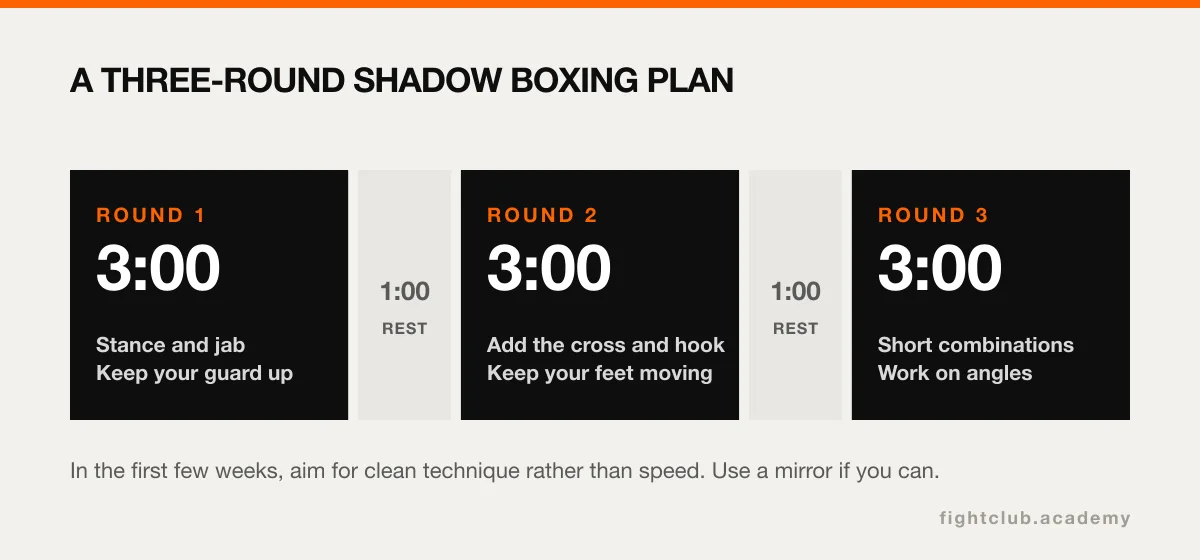
To start, three-minute rounds with a minute's rest in between is a good structure. Spend the first round on your stance and jab only; keep your guard up and your feet moving. Add the cross and hooks in the second round. In the third, turn them into short two- and three-punch combinations and follow each one with a defensive move or a change of angle.
Common mistakes
The most common mistake is speeding up. Beginners often treat shadow boxing as a chance to show how fast they can punch, and their technique falls apart straight away. Speed comes with time; in the first few weeks the goal is to make every movement clean and controlled. The second mistake is holding your breath. Breathing out sharply with each punch keeps both your pace and your stamina up. The third is keeping your chin up; tuck it slightly towards your chest and keep your eyes on your imaginary opponent.
Shadow boxing isn't a dull warm-up drill, it's a workout where you can actually watch yourself. The more regularly you do it, the more comfortable you'll feel on the bag and the pads.
All articles