
It's one of the questions we hear most from people who want to start a combat sport: boxing or kickboxing? From the outside they look very similar. The gloves are the same, the heavy bag is the same and sessions often start with a similar warm-up. But the deeper you go, the more you realise the two sports work with quite a different logic.
Techniques: punches only, or kicks too?
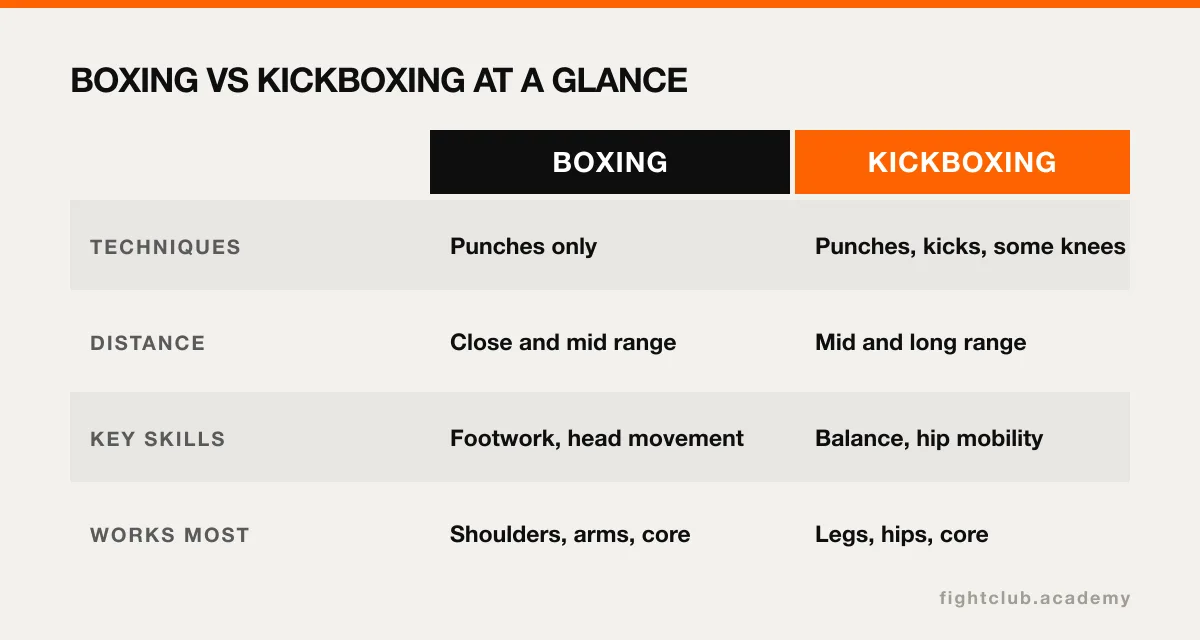
The most basic difference is the techniques. In boxing you only punch: the jab, cross, hook and uppercut. Such a narrow set of techniques means each one is drilled in fine detail. Getting the timing between your feet, hips and shoulder right for a proper jab can take months. Kickboxing adds kicks to the punches: low kicks, body kicks, front kicks and high kicks. Some styles allow knees too. A wider range of techniques means more options and a slightly more complex game.
Distance and defence
Bringing kicks into play also changes the distance. Boxers usually work at close and mid range, and footwork and head movement are vital for staying just inside or just outside an opponent's reach. Slipping, ducking and stepping back to avoid a punch is the art of boxing. In kickboxing the distance is longer and you have to watch for hands and legs at the same time. That's why the kickboxing stance is a little more upright, weight is spread more evenly and checking kicks with your leg is an important part of defence.
How each one trains your body
Those differences show up in training too. Boxing builds endurance in the shoulders, fast hands and very good footwork, with the focus on the upper body and conditioning. Just keeping your hands up for a full round is a shoulder workout in itself. Kickboxing works the legs, hips and core harder. Balancing on one leg while you kick noticeably improves hip mobility and balance over time. Both are tiring, full-body sports; the difference is mostly where the load lands.
Which is harder, which is safer?
Each has its own challenge. Boxing looks easy to learn but takes years to master. Kickboxing asks you to learn more at the start, and kicks can be tough in the first few weeks, especially if you're not very flexible. When it comes to safety, what matters isn't the sport but how the training is run. Working on bags and pads without partner contact at beginner level keeps the risk of injury to a minimum in both.
Which one should you start with?
It depends on your goals. If you want to learn hand techniques in depth and fine-tune your defence and timing, boxing is a great place to start. If you're after more variety, a pace that brings your legs into it and more flexibility, you may enjoy kickboxing more. Plenty of people start with boxing and add kicks later, and it happens the other way round too.
Being undecided is fine. A solid stance, keeping your guard up and the basic punches are shared by both sports, so what you learn in the first few weeks will be useful whichever you choose. After a trial class or two you'll feel which one you enjoy more.
All articles