
Once you start training regularly, one of the first things you'll buy is your own pair of gloves. Walk into a sports shop, though, and you'll find dozens of models with numbers like 10, 12, 14 and 16 on them. Those numbers aren't sizes, they're the glove's weight in ounces. Choosing the right weight matters both for protecting your hands and for getting the most out of training.
What does the ounce number mean?
An ounce is roughly 28 grams, so a single 16 oz glove weighs around 450 grams. The heavier the glove, the more padding it has. A heavier glove protects your hand and wrist, and the person in front of you, better. A lighter glove feels faster but doesn't soften the impact as much. Training in heavier gloves also tires your shoulders more, which makes keeping your hands up at the end of a round harder.
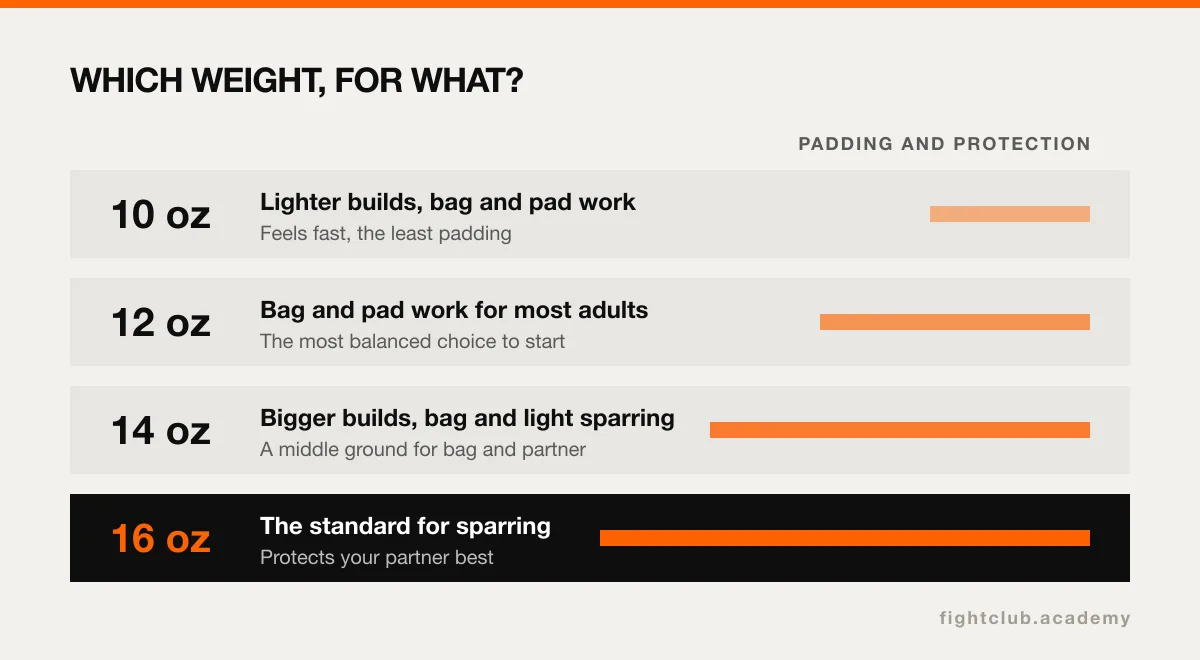
For bag and pad work
For bag and pad work, 12 or 14 oz is enough for most adults. If you have a lighter build, 12 oz is a good place to start; if you're bigger, go for 14 oz. 10 oz gloves are mostly used by lighter athletes or for speed work. They're usually not recommended for beginners, because they don't protect the wrist enough while your technique is still developing.
For sparring
For sparring, 16 oz is the usual choice. The extra padding means your partner takes less damage, and many gyms ask for that weight anyway. Since sparring won't be on the cards in your first few weeks, beginners don't need to buy 16 oz straight away. But if you want one pair for both bag work and sparring, 14 or 16 oz is the most sensible middle ground. The same sizes apply to kickboxing.
What to check when trying gloves on
If you can, try gloves on with your hands wrapped, because that's how you'll always use them in training. When you make a fist your fingers should close comfortably, the wrist should feel snug and your hand shouldn't slide around inside. Your thumb should sit in a natural position. Velcro gloves are much easier to put on and take off on your own than lace-ups; laces give a tighter fit but you'll usually need someone to help.
Don't skip hand wraps
Gloves soften the blow, but wraps are what really support your wrists and knuckles. Wraps also protect the inside of your gloves from sweat, which matters for hygiene. A wrap of around 4 to 4.5 metres is enough for most adults. Ask your coach to show you how to wrap your hands the first few times; there's a big difference between a properly wrapped hand and a quick, careless wrap.
Looking after your gloves
Don't throw your gloves to the bottom of your bag after training. Let them air out and dry, ideally somewhere open. Gloves that stay damp start to smell quickly and wear out sooner. A good-quality pair that's looked after can last a long time, even with regular training.
All articles